
Welcome to the 8th Edition of Partnership Pulse, the Australian Digital Health Agency (the Agency)’s stakeholder newsletter, designed to keep you informed and connected with key initiatives, projects and engagement opportunities across the Agency. Each edition shares updates on major programs and initiatives, as well as recent media releases and Agency news, highlights from project and program areas, opportunities to contribute through consultations, surveys, upcoming events, and learning resources to support digital health knowledge.
If this newsletter was forwarded to you and you’d like to receive future editions, you can subscribe to the mailing list.
Thank you for your continued partnership as we work together to support a more connected digital health system for all Australians.
Agency Spotlight
The Agency is progressing key conformance initiatives, including a new Enterprise Conformance Approach informed by stakeholder consultation and ongoing work to support modern, risk-based implementation practices. It is also continuing its conformance profile sunsetting program to reduce risk, support industry transitions, and ensure conformance requirements remain current and fit for purpose.
Enterprise
- The Agency recently held a consultation with stakeholders from government, jurisdictions, healthcare organisations and the software industry, providing valuable feedback and insights to help shape the future direction of enterprise conformance.
- The consultation explored how large healthcare organisations that already have strong enterprise-wide controls in place are assessed for conformance.
- Today, software products must demonstrate conformance with a prescribed set of requirements within the product itself. The proposed enterprise approach recognises that in large organisations, some of those controls may already be provided by the broader enterprise environment rather than by the software product alone.
- During the consultation, stakeholders identified Alternative Conformance Assessment Pathway as the preferred approach for enterprise conformance, recognising its flexible, risk-based model, support for contemporary enterprise implementation approaches, and ability to maintain assurance outcomes while reducing duplication.
- The Agency remains committed to working collaboratively with stakeholders as this work progresses. We encourage interested stakeholders to join the Conformance Consultation Community Forum to continue the conversation, share feedback, connect with the Agency, and engage with other digital health implementers and healthcare organisations.
Sunsetting
- The Agency continues to progress its conformance profile sunsetting activities to support safer, more sustainable digital health implementations. Regularly retiring older conformance profile versions helps reduce clinical risk, supports the transition from CDA to FHIR, and provides implementers with clear timeframes to plan and deliver upgrades.
- Sunsetting is an established lifecycle management practice and is not a new concept. First introduced in the Enterprise Pathology Conformance Assessment Scheme and Technical Framework in 2020, it supports effective conformance management by ensuring conformance requirements remain current, relevant and fit for purpose. Sunsetting does not always require a replacement conformance profile and may be used to retire outdated functionality or reduce risk exposure where appropriate.
- The Agency remains committed to working closely with software vendors, healthcare organisations and other stakeholders throughout these activities. Regular consultation with industry will continue to inform planning, support transition activities and ensure stakeholders have clear, consistent requirements that can be understood, planned for and addressed proactively.
Completed sunsetting activities include:
- Healthcare Identifiers (HI) Service: Conformance Profile (CP) versions 1.0 to 1.3 have been sunset.
- My Health Record (MHR): Advanced Care Planning v1.0, AIR v1.0, Clinical Documents v1.0 to v1.3, Consumer Entered Information v1.01 to v1.3, eHealth Pathology Report v2.0, MHR Connecting Systems v1.6, and Shared Health Summary v1.4 have all been sunset.
Current activities include:
- supporting software vendors to transition from Electronic Prescribing CP v2.3
- developing the CDA to FHIR transition plan
Upcoming sunsetting milestones include:
- 30 September 2026 – Electronic Prescribing CP v2.3 sunset
- 31 March 2027 – Electronic Prescribing client migration from CP v2.3 completed
- 30 June 2027 – HI Service CP versions 1.4 to 4.0 sunset
- 1 December 2027 – HI Service CP versions 4.1 to 5.0 sunset
Should you require any additional tailored resources, support or have any questions, please contact your Partnerships team at engagement@digitalhealth.gov.au.
Agency news
Strengthening clinical safety through new national interoperability baseline
The Agency is strengthening clinical safety across Australia’s digital health system by mandating new national interoperability standards for connections to My Health Record.
Australians already seeing the benefits of sharing health information by default
Since the Share by Default reforms took effect, Australians are already seeing the benefits, with more health information being added to My Health Record and more people using it to stay informed about their care.
With a connected healthcare team and key health information secure and in one place, Australian sprinter Lachlan Kennedy can focus on competing at his best, on and off the track.
Connected care can support people living with diabetes to have more informed conversations about their health. The 1800MEDICARE app makes it easier to access key health information from My Health Record when and where it’s needed.
Download the 1800MEDICARE app to access key health information and support more informed conversations about your care.
Highlights
New animated video helps consumers access their pathology and diagnostic imaging reports
The Agency has released a new animated video to help consumers understand how to access their pathology and diagnostic reports in My Health Record.
The video provides step-by-step guidance on accessing reports through My Health Record, either via My Health Record or the 1800MEDICARE app. It also explains when reports become available, the privacy protections and controls available to consumers, and where to go for additional support.
To help ensure the resource is accessible to as many people as possible, the video includes:
- Auslan interpretation
- Subtitles
- Clear, plain language explanations
- Step-by-step demonstrations of how to access reports.
This video has been shaped by feedback from consumer groups whose insights helped focus the video on provision of practical guidance. It forms part of the Agency’s ongoing program of consumer education resources supporting consumers to better understand and access their health information through My Health Record.
We encourage our partners to share the video with their members, communities and networks to help raise awareness of pathology and diagnostic imaging reports in My Health Record.
Learn more about improved access to pathology and diagnostic imaging reports
For healthcare providers:
- Share by Default overview
- Guide for requesting providers
- Guide for providers that undertake pathology and diagnostic imaging services
- Are the services provided in scope? - an interactive tool
- Applying for an extension of time to comply
- Resources for your patients: Consumer fact sheet
For consumers:
- Understanding better and faster access to health information
- Your questions answered: Fact sheet for healthcare consumers
- 1800MEDICARE app provides access to your health information, wherever you are.
- Viewing test results and scan reports in My Health Record
For more information, visit digitalhealth.gov.au or email help@digitalhealth.gov.au
Introducing the FHIRside Forum – Connect. Share. Shape the future of health.
A new online space for collaboration, learning, and innovation in digital health is here.
We’re excited to launch the FHIRside Forum, a dedicated online community platform designed for health professionals, innovators, and anyone interested in FHIR® standards.
What is the FHIRside Forum?
The FHIRside Forum is a central hub for ongoing discussion and knowledge sharing that you can access any time once registered.
It brings together people at all levels, from those just getting started with FHIR® standards - to experienced implementers, to collaborate and learn in a supportive environment.
It is a community built for collaboration, providing a safe space to:
- Ask questions and get practical answers
Receive productive responses from peers and experts in the community. - Share implementation experiences and lessons learned
Contribute insights to help others avoid challenges and accelerate progress. - Stay updated on best practices and emerging trends
Follow discussions and updates to keep informed with approaches to FHIR. - Connect with like-minded professionals
Engage with others working with FHIR standards across different organisations. - Catch up on previous webinars and resources
Access recordings and materials shared within the community. - Access events
Register for monthly FHIRside chats and webinars, and other learning opportunities directly through the platform.
Join the community
The future of digital health is collaborative, connected, and community-driven, the FHIRside Forum is your place to be part of it.
To participate, you’ll need to:
- Register to join Digital Health Communities
- Check your inbox, or spam for the confirmation email and verify your account
- Log in and access discussions, resources, and events via the FHIRside Forum highlight on the right-hand side:
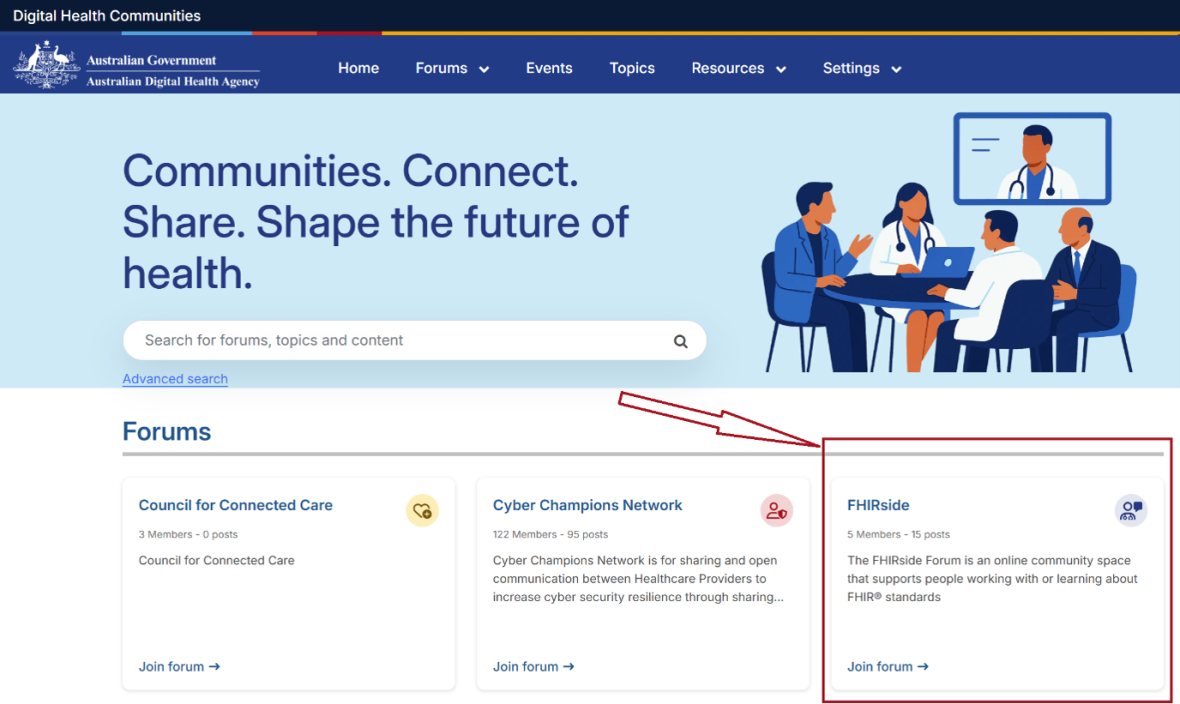
Learn, engage and grow with the FHIRside forum and register today.
Interoperability update
The 12th Interoperability Plan Progress Report (Annual Report, July 2025 – June 2026) (PDF, 1.58 MB) was published in July, marking a significant milestone with 80 per cent of actions now complete.
The report highlights the completion of two key initiatives: Action 1.10 – Integration of the National Health Services Directory (NHSD) and the Health Provider Directory (HPD), and Action 2.12 – API Information Exchange.
This progress reflects the strength of collaboration across the Australian Government and state and territory governments, working together to advance a more connected digital health ecosystem.
While reaching 80 per cent completion is an important achievement, the true measure of success lies in the benefits being delivered. These initiatives are helping to improve care coordination, reduce unnecessary duplication of tests, support safer clinical decision-making, and give consumers greater access to their health information, regardless of where they receive care.
As the focus shifts from implementation to broader adoption, the foundations established through the Interoperability Plan will continue to support a more connected, efficient and person-centred healthcare system for all Australians.
Council for Connected Care
The Council for Connected Care came together on 23 July to reflect on the progress made across Australia’s connected care and interoperability agenda and to explore the priorities that will shape the next phase of digital health reform. Members discussed developments across a range of national initiatives, considered opportunities to strengthen information sharing and connected care, and shared perspectives on the challenges and opportunities ahead. The discussion highlighted the value of bringing together leaders from across the health sector to contribute diverse expertise and help inform a more connected, safe and effective healthcare system.
The meeting also provided an opportunity to consider the Council for Connected Care Annual Review, which showcases the Council’s activities, achievements and impact throughout 2025–26. The review reflects the strong collaboration between government, healthcare providers, consumers and industry in advancing interoperability priorities and supporting improved health outcomes. The final Annual Review will be published on the Council for Connected Care webpage from 31 July 2026, providing stakeholders with an overview of the Council’s work and contributions over the past year.
National Healthcare Identifiers Roadmap
The Healthcare Identifiers (HI) Roadmap continues to progress well, with all 20 Healthcare Identifier Activities (HIAs) now underway and four activities completed. The program is increasingly moving from foundational development towards broader sector engagement and implementation.
Close collaboration with the Department of Health, Disability and Ageing and Services Australia continues to ensure alignment across the policy, operational and technical aspects of the HI Roadmap.
Recent activity has included:
- Continued development of HI policy templates and guidance materials.
- Ongoing work to improve HI Service conformance and data quality.
- Progressing key initiatives that support more accurate identity matching.
- Development of new education resources to support the use and adoption of HIs, available on the Healthcare Identifier page.
- Continued collaboration through the Healthcare Identifiers Working Group (HIWG).
Over the coming quarter, the Agency will work with co-leads to develop foundational work to support the future IHI for newborns initiative, a key activity under the HI Roadmap and broader Thriving Kids initiative.
The Agency has also recently released its annual HI Roadmap report. For more information, see the HI Roadmap page on the Agency website.
Health Connect Australia Provider Directory transition
The Healthcare Provider Directory (HPD) will transition from Services Australia to the Australian Digital Health Agency in November 2026 and will be renamed the Health Connect Australia Provider Directory (the Provider Directory), subject to a government decision and the appointment of the Agency as the HPD Operator.
As part of this transition, the Provider Directory will move to FHIR®-based APIs providing improved search functionality, support for bulk download use cases, and modern, secure, standards-based integration across the healthcare ecosystem.
The Provider Directory will also introduce a Healthcare Information Provider Service (HIPS) hosted Local Directory Solution (LDS), offering an alternative consumption model to FHIR® APIs through local directory data synchronisation.
HPD SOAP API retirement planned for June 2027
The following HPD SOAP APIs are planned to be retired:
- TECH.SIS.HI.17 – Search for Individual Provider Directory Entry
- TECH.SIS.HI.18 – Search for Organisation Provider Directory Entry
Software vendors currently using these APIs should begin planning their transition activities and assessing impacts within their products and delivery roadmaps.
FHIR® resources and API specifications
The Health Connect Australia Provider Directory FHIR Implementation Guide v26.0.0 is available now.
The FHIR® API specifications will be available from August 2026 via the Implementer Hub, enabling development, testing and transition planning activities to commence.
Further information on the HIPS hosted LDS including implementation options, technical specifications and availability, will be communicated in future updates.
| August 2026 | FHIR® API Specifications available. |
| November 2026 (subject to government decision) | ADHA is appointed HPD Operator |
| Early 2027 (planned) | Software Vendor Test (SVT) environment and conformance processes. |
| June 2027 (planned) | Retirement of HPD SOAP APIs: TECH.SIS.HI.17 and TECH.SIS.HI.18. |
| TBC | HIPS hosted LDS implementation and onboarding information |
What this means for software vendors
Software vendors currently using TECH.SIS.HI.17 or TECH.SIS.HI.18 are encouraged to review the FHIR® Implementation Guide, the upcoming FHIR®-based API Specifications and begin planning their transition to the Provider Directory ahead of the planned retirement of the HPD SOAP APIs.
This will help:
- assess business and technical impacts,
- plan development and testing activities,
- schedule transition work within product roadmaps, and
- prepare for migration ahead of HPD SOAP API retirement.
Further information on the HIPS hosted LDS, including implementation options and availability, will be provided in future updates.
For questions or support, please contact the Health Connect Australia team at HealthConnect@digitalhealth.gov.au
Healthcare Information Provider Service (HIPS) – Sunsetting legacy versions
The Agency is taking a planned, risk-based approach to sunsetting older HIPS versions to support the ongoing security, integrity and interoperability of national digital health infrastructure. This approach is consistent with the Agency’s broader management of conformance profiles and reflects the need to address risks associated with older HIPS versions, including:
- Alignment with the My Health Record Connecting Systems Security Conformance Profile and contemporary security expectations.
- Reduction of operational and support risks associated with legacy technology.
- Simplified support and maintenance across the HIPS product suite.
- Improved patient identity matching and validation capabilities available in HIPS v9.1, including validation associated with Individual Healthcare Identifier (IHI)
Readiness to adopt future enhancements, including proposed capabilities for HIPS FHIR-based integrations
The timeline for sunsetting older versions of HIPS is as follows. Sites will need to upgrade to the latest version 9.1 to continue to access national infrastructure and the My Health Record.
- v6.x – 31 March 2027
- v7.x and v8.2.1 – 31 August 2027
- v8.3.0 and v8.3.1 – 30 November 2027
The Agency will be communicating this with all HIPS customers via letter, seeking upgrade plans and provide support to customers as they transition.
Education update
The Agency’s Education team produces a range of free online eLearning resources and factsheets to support digital health learning for everyone.
This includes translated consumer factsheets about My Health Record, the 1800MEDICARE app and electronic prescriptions in:
- Arabic
- Dari
- Greek
- Hindi
- Italian
- Korean
- Nepali
- Punjabi
- Simplified Chinese
- Sinhalese
- Spanish
- Tagalog
- Tamil
- Traditional Chinese
- Urdu
- Vietnamese
Visit Resources to find and download these factsheets.
Also available are a range of resources from our stakeholders including My Health Record storybooks, easy read resources, LGBTIQ+ factsheets and plain language videos.
Cyber Champions Network
“Every cyber champion is proof that cyber resilience is built from the ground up, and together we are shaping a stronger, safer healthcare sector”
Why become a Cyber Champion?
Australia’s healthcare sector is facing ever-evolving cyber threats, and now more than ever, building a strong cyber security culture is vital. The Australian Digital Health Agency is helping to empower healthcare professionals to proactively understand and defend against cyber risks through the Cyber Champions Network.
What is the Cyber Champions Network?
The Cyber Champions Network is a community of healthcare professionals with the collective goal to foster a proactive, engaged, and security-conscious healthcare ecosystem. Together, members are strengthening Australia’s collective cyber defences and enhancing the sector’s ability to respond to emerging threats.
National uptake
Since its launch in August 2024, the program has achieved strong national engagement, with 148 participants across 111 healthcare organisations across Australia successfully completing the course. Participating organisations have deepened their understanding of cyber threats and significantly increased their resilience to cyber-attacks.
How does the program work?
Participants take part in five interactive fortnightly sessions, each running for 90 minutes. The program is designed to build positive cyber behaviours, including:
- Understanding the cyber security threats and risks currently affecting Australian healthcare organisations.
- Learning best practice approaches to securing systems and information.
- Recognising that cyber security is everyone's responsibility, including understanding the impact of social media and digital footprints, as well as supply chain risk and vendor management.
- Building cyber resilience through the development of a cyber incident response plan and a cyber security awareness program.
In addition, Cyber Champions gain access to a wide range of ongoing resources and practical tools to uplift cyber awareness and foster a strong security culture within their organisations.
Participant feedback
“This program provided clear, up‑to‑date cybersecurity awareness tailored for small to medium allied health practices. It covered real‑world threats, practical prevention strategies, and effective response measures, empowering both management and staff to protect patient data and business operations. I highly recommend this training to all allied health clinics in primary health care. it’s an invaluable step toward building a strong, organisation‑wide cybersecurity culture.”
- Board Director, Allied Health Network
Ready to join?
Participation in the Cyber Champions Program is free.
New cohorts will commence on:
- 1 September 2026, and
- 10 September 2026
Don’t miss this opportunity to become a leader in cybersecurity within your healthcare organisation. Take the next step to protect your organisation and join the Cyber Champions Network today!
Register your interest: Join the Cyber Champions Network.
Learn more about Cyber Security?
Our Cyber Security Team monitors digital threats relevant to healthcare and issues timely alerts on vulnerabilities and cyberattacks. Stay informed by subscribing to Cyber Alerts.
My Health Record legislative transition period ending soon
The My Health Records Rules 2026 (the 2026 Rules) came into effect on 1 April 2026. Existing participants (registered for My Health Record prior to 1 April 2026) were provided a 6-month transition period (until 1 October 2026) to continue applying relevant provisions of the My Health Records Rule 2016 (the 2016 Rule) relating to security and access policy requirements. As we approach the end of the transition period, existing participants should ensure they are preparing to meet their obligations underthe 2026 Rules.
New participants (registered on or after 1 April 2026) are already required to comply with the 2026 Rules.
This means that from 1 October 2026, all participants will be expected to comply with the requirements set out in the 2026 Rules.
Updated guidance now available
The Agency has updated its My Health Record participation obligations webpage with information and guidance to help participants understand and meet their obligations under the 2026 Rules, including requirements for establishing and maintaining a compliant security and access policy.
Participants are encouraged to review the updated guidance and ensure their policies, procedures and practices align with the requirements of the 2026 Rules.
Security and Access Policy template under development
In addition to updating guidance on its webpage, the Agency is developing a new My Health Record Security and Access Policy template for Healthcare Provider Organisations in collaboration with the Office of the Australian Information Commissioner (OAIC). The template is intended to support participants in meeting their security and access policy obligations under the 2026 Rules.
Further information and guidance will be communicated to participants once the template becomes available.
Security conformance implementation for My Health Record connected systems reaches mid-point
The implementation period for the My Health Record Connecting Systems Security Conformance Profile v1.0.1 is now at its halfway point.
The implementation period commenced on 23 February 2026 and concludes on 22 February 2027, providing connected organisations with a 12-month transition period to demonstrate conformance with the updated security requirements.
Organisations connected to the My Health Record system should be actively progressing:
- Review of the Security Conformance Profile requirements.
- Planning and implementation activities within product and organisational roadmaps.
- Security assessment preparation and scheduling.
- Submission of conformance requests through the Digital Health Implementer Hub.
The Australian Digital Health Agency encourages organisations to commence assessment planning as early as possible. Early engagement allows the Agency to provide support throughout the conformance process, coordinate assessment scheduling, and help manage demand as the implementation deadline approaches.
This reminder forms part of the Agency's planned implementation communication program and is intended to support organisations in meeting their obligations while avoiding delays associated with late-stage assessment activity.
Further information on the security requirements, supporting resources and activities required to progress through the conformance process is available via the My Health Record Connecting Systems Security Conformance Profile v1.0.1 page on the Digital Health Implementer Hub.
Resources available include:
- My Health Record Connecting Systems Security Conformance Profile Implementation Timeline
- My Health Record Connecting Systems Security Conformance Profile v1.0.1
- My Health Record Connecting System – Conformance Assessment Scheme v2.0
- My Health Record Connecting Systems Security Conformance Profile – FAQ
For assistance, organisations can contact the My Health Record Help Line on 1300 901 001 or email help@digitalhealth.gov.au.
National Clinical Governance Committee for Digital Health
The National Clinical Governance Committee (NCGC-DH) has continued its momentum to strengthen safety and quality of digital health products, services and initiatives including virtual care and artificial intelligence enabled care.
Safe use of virtual care
At its July meeting, the NCGC-DH discussed two key priorities to improve the safe use of virtual care, including the expansion of Share by Default requirements to medicine-related information and the development of safety and quality standards.
Share by Default for medicines information
Firstly, members discussed the Government’s announcement to establish the National Medicines Record and the expansion of Share by Default requirements to medicine-related information, commencing with online prescribers. These initiatives aim to improve medicines safety and enhance coordination and continuity of care by increasing the sharing of medicines data through My Health Record.
Members highlighted key implementation considerations, including defining scope across care settings, improving completeness and accuracy of data, and prioritising high-value use cases.
Safety and quality standards
Secondly, members discussed the Australian Commission on Safety and Quality in Health Care’s (the Commission) work to develop national safety and quality virtual care standards. These standards will build on the Commission’s National Model for Clinical Governance and will establish clear and consistent expectations for high-quality care delivered virtually, whether through hospitals, primary and community healthcare, or commercial providers.
Members highlighted the importance of broad stakeholder and consumer engagement, the need for clear guidance on the interactions between different standards, workforce capability uplift and escalation pathways.
Across both the National Medicines Record and the virtual care standards, members discussed the importance of interoperability and the need to ensure consumers and providers are well informed about privacy, consent, data use, and information sharing.
Artificial Intelligence Enabled Care
The NCGC-DH discussed key focus areas relating to artificial intelligence (AI) enabled care which will be considered over the coming months, including the overall forward workplan for the AI Enabled Care EAG. These areas include guardrails for AI use with national digital health infrastructure, mechanisms to encourage the appropriate and clinically safe use of digital scribes, and the potential development of a certification or assessment framework for AI tools used for healthcare purposes.
National Framework for Digital Health Standards
The NCGC-DH is also supporting progressing the National Framework for Digital Health Standards (Standards Framework) which sets out a nationally coordinated approach to the adoption, implementation and development of digital health standards.
More information:
Find out more about the NCGC-DH.
Opportunities to contribute
There’s still time to share your insights on Real-time Prescription Monitoring (RTPM)
The Agency would like to thank the hundreds of clinicians, including pharmacists, doctors, nurse practitioners, and dentists, who have so far responded to the Real Time Prescription Monitoring Survey that we launched in July. The survey remains open until Friday 18th September 2026, so there is still time to make your voice heard!
This feedback from users of the various Real Time Prescription Monitoring systems around the country (e.g. SafeScript, QScript, TasScript) will help guide ongoing management and improvement initiatives. If you rely on one of these systems when prescribing or dispensing medicines but haven’t taken the opportunity yet, we would greatly appreciate it if you could share your thoughts with us – the survey only takes 15 minutes to complete.
Upcoming events
Digital Health eLearning Showcase
Date: Tuesday, 1 September 2026
Time: 1:00pm - 2:00pm AEST
Location: Microsoft Teams
Explore Digital Health eLearning with the Agency
Join the Agency for our inaugural Digital Health eLearning Showcase and discover how your organisation can use digital health education resources to build workforce capability and support the adoption of digital health tools.
During this online showcase, representatives from the Agency's Education, Partnerships and Cyber Security teams will:
- showcase the range of digital health eLearning courses available to healthcare professionals, organisations, students and consumers
- highlight how these resources support digital health capability uplift across the healthcare sector
- provide an overview of options for hosting Agency eLearning courses within your organisation's Learning Management System (LMS), including SCORM access, licensing requirements and implementation considerations.
Attendees will also have the opportunity to ask questions and engage directly with Agency representatives.
Review the agenda for more details.
Can't attend live? Register anyway to receive a recording of the session, presentation slides, and links to the Australian Digital Health Agency eLearning Courses and Hosting Guide and Agency eLearning Courses – External Hosting Request Form following the showcase.
SNOMED CT EXPO 2026 comes to Sydney – An opportunity not to be missed!
Australia’s digital health, terminology and interoperability community has a unique opportunity this October, with the SNOMED CT Expo 2026 being held in Sydney from 21–23 October 2026.
This is an exceptional chance to connect with experts, health system leaders and standards practitioners, from around the world and in the same location.
Hear from Local and Global Leaders tackling real-world challenges
The Expo brings together jurisdictions, health organisations, technology vendors and thought leaders from around the world who are addressing many of the same health data challenges faced in Australia.
By attending, you will have the opportunity to:
- Learn how other health systems are advancing interoperability and clinical terminology adoption.
- Gain practical insights from large-scale implementations of SNOMED CT, medicines terminology and FHIR-enabled solutions.
- Explore emerging international directions in semantic interoperability and health standards.
- Connect directly with implementation experts, public sector leaders, vendors and global standards organisations.
- Take home practical lessons and proven approaches that can support current and future digital health initiatives.
- Connect with organisations shaping the future of digital health
- Explore the future directions for SNOMED CT, FHIR implementation. Medicines terminology and more
The SNOMED CT Expo is more than an event, it's an opportunity to build knowledge, exchange ideas and help shape the future of interoperable healthcare.
View the full program and register today!
Use discount code EARLYAU to access the early bird registration rate of $870 until 31 August 2026.
Don't miss this opportunity to learn from global experts, connect with peers and be part of the conversations shaping the future of health interoperability and connected care.
Learning Spotlight
My Health Record training
Healthcare provider organisations must provide staff with My Health Record training before they are authorised to use their system, following any significant changes to My Health Record legislation and annually. There are a range of options for training available. For more information check out the Recommended My Health Record Training factsheet.
The Agency's Education team works in partnership with Primary Health Networks (PHNs) to support the delivery of digital health education initiatives across local health communities. Through this collaboration, PHNs help raise awareness and understanding of national digital health tools among healthcare providers and organisations within their regions, including My Health Record, electronic prescribing and healthcare identifiers.
For information about digital health education and support available in your region, contact your local PHN.
Use the PHN locator map to find your local PHN and contact details.
Did you know ...
For a consumer to view their Active Script List (ASL) in the 1800MEDICARE app, they require an activation code to link their ASL to the application.
The activation code must be provided by a pharmacist. Each activation code is unique to the individual consumer, allowing them to use their specific code repeatedly to link their ASL to various third-party applications.
This activation code is available via the pharmacy’s dispensing software. Learn more about activation codes and how to generate one with our short educational video.
Or to learn more about ASL and how it supports electronic prescriptions, visit the electronic prescribing for dispensers webpage.
Inside Digital Health
While Partnership Pulse keeps you up to date with our projects and programs, the Agency's Inside Digital Health newsletter on LinkedIn takes a wider view. It's all about innovations, global trends, and sector-wide updates, perfect for keeping up with the bigger digital health picture.